
The Eastern Black Walnut (species: Juglans nigra) is a tree in the Hickory family that is prized for its high value wood. It is a close relative of the "
English Walnut" (also called the Persian Walnut) which is the primary Walnut species for edible Walnuts. It is native to much of central and eastern North America and has been introduced into Europe for several centuries.
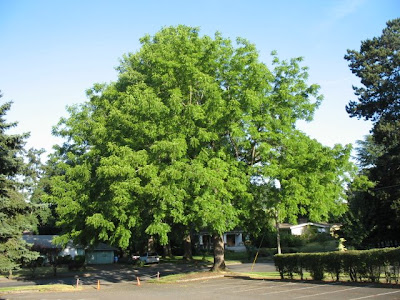
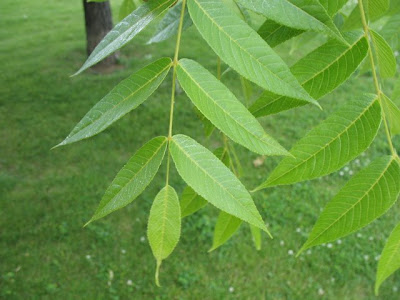
The leaves of the Black Walnut are alternate and odd-pinnate with the individual leaflets being more slender and pointy than those of the English Walnut. By its leaves the Black Walnut can be easily confused with the "
tree of heaven" or the "staghorn shumack".
The fruits of the Black walnut are edible but have smaller meats and are harder to harvest than those of the English walnut. Black walnut fruits are harvested mostly from wild trees.
One curious fact about the Black walnut is that its leaves, drupes and roots produce a substance called juglone that is a natural dye. At certain times of the year the leaves of the tree are coated with a glossy layer of this substance which can also have adverse affects on other plants such as tomatoes.
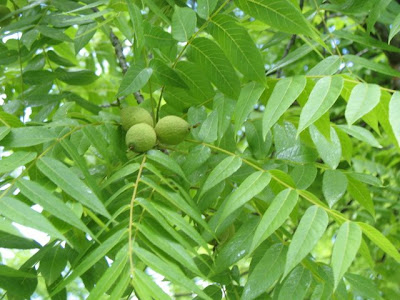
On mature trees the walnut fruits are a dead give away as to its tree family. In cities where the Black Walnut and the Tree of Heaven grow in close proximity there are times when the young trees may be hard to tell apart. If the small tree you are trying to identify has appeared in your hedge, fence line or along the side of your house and is rather fast growing there is a very good chance that it is the Chinese "Tree of Heaven" tree which in my opinion is one of the most invasive trees in the United States and Europe. If you live within a block or two of one watch out for volunteers!
One way to tell a Black Walnut apart from the tree of heaven is by its bark. The Black walnut's bark is dark brown and deeply furrowed. The Tree of Heaven's bark on the other hand is brownish gray and smoothish with a bit of a rough texture. It is never furrowed like the Black Walnut's.





 The Cherimoya or Custard-apple (species: Annona cherimola) is an edible fruit tree native to the Andes mountain region of South America. It is now widely planted as a fruit tree. The images in this post are from the south of Spain near the city of Málaga.
 The leaves of this spreading tree are about 3-5 inches long with a simple ovate shape, pinnate venation and entire margins. They are also a bit warped.
 The fruit of the Cherimoya is irregular and "heart" shaped in its own unique way. The ripe fruits are green with a smooth skin and a distinct pattern (see image below).
  The flesh is a creamy color and quite soft and smooshy when ripe making it easy to eat with a spoon.
 The seeds are roughly almond shaped and black. They are fairly easy to spit out when you get one or several in your spoonful of the soft sweet flesh.
 The bark on younger trees is smooth but rough and cracked on older trees like the one below.

 The Eastern Black Walnut (species: Juglans nigra) is a tree in the Hickory family that is prized for its high value wood. It is a close relative of the "English Walnut" (also called the Persian Walnut) which is the primary Walnut species for edible Walnuts. It is native to much of central and eastern North America and has been introduced into Europe for several centuries.
  The leaves of the Black Walnut are alternate and odd-pinnate with the individual leaflets being more slender and pointy than those of the English Walnut. By its leaves the Black Walnut can be easily confused with the "tree of heaven" or the "staghorn shumack".
  On mature trees the walnut fruits are a dead give away as to its tree family. In cities where the Black Walnut and the Tree of Heaven grow in close proximity there are times when the young trees may be hard to tell apart. If the small tree you are trying to identify has appeared in your hedge, fence line or along the side of your house and is rather fast growing there is a very good chance that it is the Chinese "Tree of Heaven" tree which in my opinion is one of the most invasive trees in the United States and Europe. If you live within a block or two of one watch out for volunteers!
 One way to tell a Black Walnut apart from the tree of heaven is by its bark. The Black walnut's bark is dark brown and deeply furrowed. The Tree of Heaven's bark on the other hand is brownish gray and smoothish with a bit of a rough texture. It is never furrowed like the Black Walnut's.

