


Shape: Lobate
Margin: Serrate
Consistency: thick and stiff
Venation: Reticulate
Texture top side: Rugose
Texture reverse: Pubescent
Color: bright green, yellow-orange in autumn
Petiole: 2-6cm



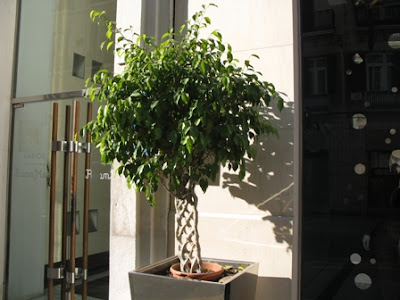 #One - Make sure that your Ficus plant is getting the right amount of sunlight. Ample light is necessary and some direct light for part of the day is fine but avoid a location that exposes to plant to direct sunlight for too long. Also keep in mind that these plants are very sensitive to changes. It is not uncommon for a Benjamin Fig to drop all of its leaves in response to a dramatic change. The trick is to find a good location and then don't move it!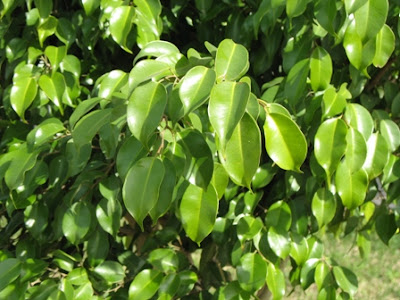
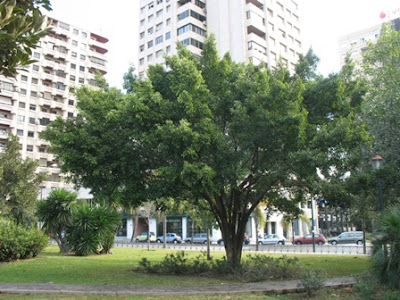
 The Fiddle Leaf Fig tree is commonly used as an indoor potted plant. It is relatively easy to care for, has large beautiful leaves and has a slow rate of growth. In this post I will list seven tips for caring for this tree species in an indoor environment as well as links to sites with more information.
 Tip #One
  Tip #Three
 Tip # Five
 The Council tree (Ficus Altissima) is a large leaf "fig" that is sometimes used as an indoor potted tree species. It is not nearly as common however as its close relatives the Rubber tree, the Fiddle Leaf Fig, the Ficus Benjamina, the Sacred Fig or the Edible Fig. The leaves of the Council tree are quite large measuring about 10-12 inches in length and 5-6 inches in width. They have a simple elliptical shape and pronounced pinnate veins that have about an eighth inch relief on the reverse side and are alternate.
 The "Fig" of the council tree is almost as large as a normal edible fig but with a more rounded, oblong shape. The fruit color ranges from yellow to orange to almost red and they present a series of "spots" as you can see in the image below. These figs measure about 1-1.3 inches in length. I cut one of the figs open to get a picture of the inner detail. It was quite a bit harder and more difficult to cut than an edible fig but the smell was similar. I do not know whether these figs are edible or not and while tempted I refrained from giving one a bite.
 The light grey bark was similar to some other "Banyan trees" but I did not see any evidence of "prop-roots" although the tree here photographed may have been too young still to have this feature. These trees have been planted in several parks and avenues in Malaga, Spain but are not common. The tallest ones that I have seen are about 35 feet tall.
 The Edible Fig tree (Ficus Carica) is, as it´s name quite obviously suggests, the source of edible figs. This is not to say that it is the only member of the Ficus genus with edible fruit, there are several others. Rather it is the fruit of this tree that is widely commercialized as "figs" and used to make fig cookies, fig bread, fig liqueur, dried figs etc. There are several varieties of this tree widely cultivated in Southern Europe. One produces dark purple colored figs and the other green figs. Both of these taste pretty much the same in my opinion.
 In the picture above you can appreciate how the figs grow on the branches at the base of new leaf stems. Not all of these reach maturity as some will get knocked off or be eaten birds or other hungry critters. When the figs are detached from the branch there is a white milky liquid that "bleeds" from the spot where the fruit was connected.
 Unlike most "figs" (members of the ficus genus) the Ficus Carica is a deciduous tree (leaves turn color in autumn and fall off leaving the tree bare all winter). The images above and below show the typical leaf shape in summer and in fall. These are fairly large leaves that measure 8-10 inches (24cm) across. The leaf presents rather pronounced lobes with a palmate venation (3-5 main veins).
 The image below is of a typical fig tree in the courtyard of an Andalusian "finca" located not far from the city of Antequera. This tree can be climbed to harvest the fruit but with great care as the branches break easily producing damage to the tree and possible harm to the person who could fall while reaching for the ripe fruit.
 The picture below is of the biggest Ficus Carica that I have seen yet. It is located on the outskirts of the town of Yunquera in Southern Spain in an area that has multiple fresh water springs. My own estimates are that this tree is about 4-5 feet in diameter at the base, about 60-70 feet tall and probably 400-500 years old.
 The term “Banyan” is used to refer to several species of trees from the genus “ficus” (figs). The common trait that sets apart figs as Banyans is the ability to send down “aerial roots” from the main branches which in time grow into new trunks or merge with the main trunk creating a massive tangled bulk that can reach diameters up to
Another fig species that is often referred to as “Banyans” is Ficus Macrophylla which goes by the common name Moreton Bay Fig. The images in this post are of some large
 In the image above you can make out the shape of the leaves and fruit. The leaves are simple in shape and are dark green and smooth. The measure about 15-20 cm in length. The fruits are small "figs" but are not edible like some of the other members of the ficus genus. (ie ficus carica).
 Another characteristic of the Moreton Bay Fig are large buttress roots that serve as additional support. These roots that protrude above the ground an extend quite a ways our from the base of the tree as you can see in the image above.
 Another fig species that sends down aerial roots and can have a similar appearance is the Ficus Elastica or Rubber tree.
 The Rubber tree (Ficus elastica) is one of the "figs" that is popular as an indoor potted tree. In the right growing conditions however it can grow to become a large tree. I have seen this tree reach heights of 20 meters with a broad spread.
 The fruits of the Ficus elastica are small, measuring only 1-1.5 cm in length. The leaves however are large and showy. They are tough leaves with a shiny dark green color. I´ve seen some of these trees with such a dark green color almost reaching a dark purple green (see below).
 The image above was taken in the town of "Rincon de la Victoria" east of Malaga in Southern Spain.
 I took the picture below while waiting for a bus in central Malaga. As I waited I noticed the roots that this tree was dropping down from is lower branches. When these roots reach the ground they become additional trunks that help support the weight of the large branches.
 The Fiddle leaf fig (Ficus lyrata) is a large leafed member of the ficus genus and one that is valued as an ornamental tree for both indoor and outdoor environments. This is not the tree that "edible" figs come from (that would be the Ficus carica) but its fruit does come close in size and resemblance. One difference is the characteristic spotting on the the Fiddle leaf figs.
 The leaves of the Fiddle Leaf fig are some of the largest among the fig family (if not the largest, although I´m not sure on this point). The leaves can measure up to 45 cm long and 30 cm wide. The common name in English comes fromt the "Fiddle shape of the leaves - sort of like a pear).
 It is very common to find this tree in parks and gardens in Southern Spain. It is also very commonly sold as an interior potted tree. I have seen them in size from 75cm tall up to 3-4 meters tall.
 Below is the fruit which is about 4cm long and pretty round in shape. The one on the right is a dried one I found on the ground.
 The Ficus Benjamina is a very interesting and sought after ornamental tree. It is probably one of the most common "indoor" trees. It is also commonly used as a bonsai tree. It is not however a small tree. In its native environment it can grow quite large (over 20 meters).
 Where I live the Ficus Benjamina is common both as an indoor tree and as an ornamental tree in gardens, parks and along avenues. As its name indicates this tree is a member of the Ficus (Fig) genus. In one of the images below you can see the fruit of this tree which are little "figs" (not the edible kind - Figs that we commonly eat are from the Ficus Carica tree)
 This tree is sometimes called the "Weeping Fig" or "Benjamine Fig". One interesting piece of trivia about this tree (and all Ficus for that matter) is that it needs an associated pollinator wasp in order to reproduce naturally. I´m not excactly sure how this works but it has something to do with a specific species of wasp that will only lay its eggs in one specific species of ficus and in so doing pollinates the tree.
 The image below is in the "Jardines de Picasso" in Malaga, Spain. This is a little know garden/park that is divided into four sections by the intersection of two main avenues. If you take the time to explore though it you will find that it has an amazing collection of trees, some of which are very large. A local once told me that this park was once the private estate of a wealthy family who owned a shipping company that operated out of Malaga.
