The Beauty of Autumn


Few things are more beautiful than trees in their autumn colors.  The image above is of a ripe acorn of a Portuguese oak in fall color.


A heart shaped poplar leaf resting on a moss covered rock.


An old wood gate in a rock wall beside a Walnut tree.


Looking up into the branches of a Large Leaf Linden in full Autumn color.


Spotten leaves with a Leopard like pattern.


Montpelier Maple leaf in red fall color.


Cottonwood leaf floating in a stream.

Horse Chestnut - Buckeye images

I came across a Horse Chestnut tree (also called Buckeye in some parts) earlier this year at a moment when the spiky green seed pods were at a very intriguing stage in their formation.  They looked like what you might imagine a bacteria would look like under a powerful microscope, with an almost alien look.  The lighting conditions were such that I was able to take few pictures in which the soft lighter green spikes really stood out against the background.  Perhaps these images speak for themselves without further explanation.

Some of the little spiky balls had just formed from the flower stage and were not much larger than a marble.

I also got a couple of interesting shots of the Horse chestnut leaf margin (below) and the leaf stem.
In this image one can see how the Horse chestnut palmate leaf attaches to the stem.  This is one good way to help distinguish this tree from the true Chestnut Castanea sativa.

Chestnut Season

It is Chestnut season once again which means that this is a good time to revisit the question of how to tell an edible Sweet Chestnut from a non-edible Horse Chestnut (also called Buckeye).  I will first provide some images to help accurately identify the edible Sweet Chestnut and then I will provide some for the non-ebible Horse Chestnut.

First the edible Sweet Chestnut from the Castanea sativa tree...

The image above is of the Sweet Chestnut leaf


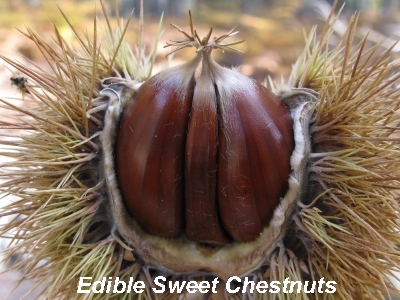
The seed pods of the edible Sweet Chestnut are very easy to distinguish from the non-edible Horse Chestnut.  Those of the edible chestnut are very "spiky" with sharp, pointy, needle-like spikes that are about 2cm long.  The spikes completely cover the surface of the edible Sweet chestnut´s seed pod.


Non-Edible Horse Chestnut of the Aesculus hippocastanum tree...

The seed pod of the non-edible Horse Chestnut (also called Buckeye) is quite different.  It has short stubby points that are not as stiff nor as sharp as those of the edible Sweet Chestnut.  It´s stubby spikes do not cover the whole surface of the seedpod and are only about half a centimeter in length. 


The image below is of the Horse Chestnut seed outside of its seed pod.  These round but somewhat irregular shaped seeds range in size from approx. 2-4 cm in diameter.  One way to tell them apart from edible chestnuts is by the fact that these seeds have no pointy end whereas the edible Sweet Chestnuts always have a pointy end.


A word of caution for chestnut hunters who live in areas where both the Horse Chestnut and Sweet Chestnut trees grow.  Don´t trust a chestnut just because you found it near or under a sweet chestnut tree.  It is not uncommon for these two trees to grow in close proximity to each other in city settings.  Edible chestnuts always come from very spiky seed pods and always have a pointy end on the seed.

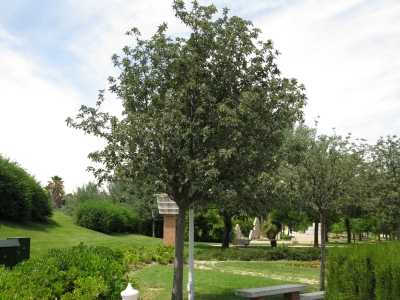
Swedish Whitebeam - Sorbus x intermedia


Common name(s):  Swedish whitebeam
Scientific name:  Sorbus x intermedia (triple hybrid between s. aucuparia, s. torminalis, s. aria)
Family:  Rose - Rosaceae
Native range:   Southern Sweden and nearby areas
Type: deciduous
Non-native range:  Planted as an urban ornamental tree
Average height range:  10 - 20 meters
Forest or habitat:  
Wood density and quality:  
Leaf shape: orbicular - obtuse (almost circular)
Leaf arrangement:  
Leaf margin:  lobate - serrate
Leaf venation:  pinnate
Leaf stem:  1cm approx.
Leaf surface:   dark green, glabrous, (Reverse - grayish-green, pubescent (hairy))
Inflorescence: Corymb
Flower: White, 5 petals, 1cm
Reproduction: tetraploid apomictic
Fruit: Orange to read oval pome
Edible?:  no
Seed dispersal mechanism:  birds (Thrushes and Waxwings)
Bark:  Gray  and fairly smooth
Traditional uses:  ornamental
Commercial uses:   ornamental
Invasiveness:   unknown


_______________________________
Árboles madrileños, Antonio López Lillo y Antonio López Santalla, 2007, Obra Social Caja Madrid.