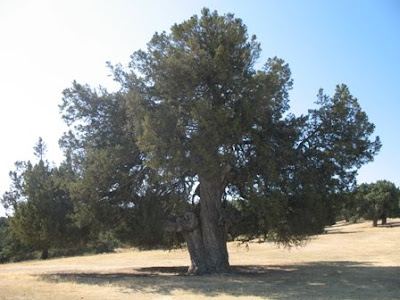
The Spanish Juniper (Juniperus thurifera) is a member of the Juniper family that is native to the Western Mediterranean region. In Spanish this tree is normally called "Sabina" but in some regions such as Segovia it is referred to as "Enebro" (Common Juniper). The pictures in this post were all taken in the "Enebral" (forest of Enebro) of Hornuez as it is called locally even though it is in fact a "Sabinal" (forest of Sabinas).
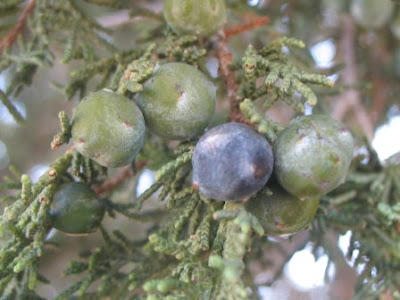
The seed cones of the Spanish Juniper (above) are round "berries" about the size of peas and change from green to dark purple as they mature. The male and female trees are seperate. The male trees have small polen cones (below) that look a lot more like what you would expect a cone to look like but are very small. I estimate that these were about 2-3 mm long. The ones on the left are new green cones and the ones on the right are mature cones that have released their polen.
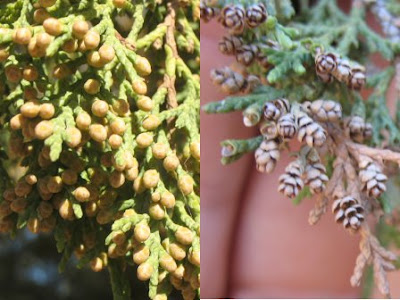
The "leaves" of the Spanish Juniper are very similar to the Mediterranean Cypress (Cupressus sempervirens) but are easily distinguished from the Common Juniper which has much more pointy, needle-like leaves.

I´m not really sure what the thing in the picture below is. I saw these growing on the female trees and I am guessing that it might be a precurser to the berry like fruit. If you know better please leave a comment.

The pictures below are of the young trees. The Spanish Juniper has considerable difficulty germinating and surviving as a young plant (the sheep and goats like to eat them) so they sometimes need a bit of protection like the one on the left.

The "Sabinal" or Spanish Juniper Forrest at "Hornuez del Moral" is an ancient forest with many very old specimens. Some of the locals say that the trees may be as old as 1,000 years but a more conservative estimate would probably be more like 500 years. At any rate they are some of the oldest Spanish Junipers in the world without a doubt.

This particular forest of Spanish Junipers is quite famous locally as a sight of a supposed aparition of the Virgin Mary. According to this tradition this forest is called the "Bosque de Milagros" or "forest of miracles".

Below is a synopsis of a sign that is located in front of the Hermitage (above) that still contains the famous Juniper trunk...
"Late one evening in the fall of 1243 a couple of shepherds, who were taking their flocks from Soria to Extremadura, stopped to spend the night at Hornuez (Segovia region) within eyesight of the peaks of Somosierra. They decided to make camp at the base of a Spanish Juniper tree and after gathering a bunch of dry branches tried to light a fire. But try as they would they were unable to get their fire going. After trying in vain some time the shepherds were shocked when the branches of the Juniper tree parted and revealed the radiant form of the Virgin Mary as if she was carved right into the trunk of the tree. It was the Virgin Mary who was keeping the men from lighting their fire at the base of this special tree. The shepherds ran into the nearby town and spread the word of the apparition. The site became well known and a hermitage was built to protect the special tree. Over the centuries the hermitage has been rebuilt until it reaches its current form as a very large "santuary" for the virgin and the supposed trunk of the original tree which the locals say has been miraculously preserved. Twice a year one the last Sunday in May and the second Sunday in September there is a "Romeria" (parading the statue of the virgin) at the site. Even though the population of the town is less than a few hundred there are over 1,000 members of the brotherhood that parade the virgin and several thousand show up for the May and September celebrations."

 The European Black Pine tree (Pinus Nigra) is called "Pino Negro" in its native Spain (its native range is actually quite broad and extends from North Africa all across Southern Europe and into Asia. It has relatively small cones as far as pines go. The cones in these pictures were about 6-7 cm long (2 inches). I found the black stripe down the middle of the scales (above) very interesting. These newly opened cones had an almost perfect shape. As they dry and turn more of a grey-brown color this stripe seems to fade.
 The image below is of the polen cones.
 One of the stand of this tree species that I found was of trees that were quite straight and tall (25 meters, 75 feet). In the vicinity of this tree stand there were numerous Atlas Cedars.
 The image below is a detailed drawing of the European Black Pine´s various parts.


