
 The contributing blogs to this months edition are...
Bushranger
C´mon Let´s Plant a Tree
AdmirableIndia.com
A Neotropical Savanna
Arboreality
Charles Darwin´s Beagle Diary
papayamaya.blogspot.com
Bolts of Silk
Anthony McCune, The Lives and Times...
The North Canton Beat . . .
qarrtsiluni.com
Boobook at "Bushranger" contributes a post entitled Planting for the Future where apart from reminding us about the importance of tree planting she also posted some great pictures of a Bell-fruited Mallee Eucalyptus preissiana one of which I´ve included below.
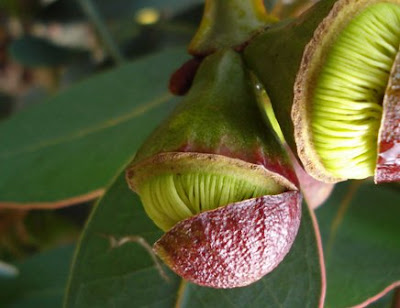
Vinayaraj at "C´mon Let´s Plant a Tree" contributes a post entitled Invest in the Future: Plant a Tree
"...There still are many factors to consider when planting a tree. The first one, and I should have mentioned it last time, is a call to Miss Utility, (800) 552-7001 or simply 811. Planting a tree isn’t like slipping petunias in. You’re dealing with a big hole and big roots. The utility companies will mark your lines within seven days of your call. So much easier than digging into your gas line. Also, 10 years down the road, when your water line needs repair and your tree has to be uprooted, you’ll wish you had called..."
Maneesh in bangalore writes in his blog AdmirableIndia.com
JLB at Arboreality presents an extensive interview of Dr. Nalini Nadkarni, author of Between Earth and Sky: Our Intimate Connections to Trees. Here is an excerpt from the interview
JLB - Now that Between Earth and Sky has its first chance to speak to an audience, what are your hopes? What do you most want readers to take away from this book?
My hope is that after readers finish this book, they will say, wow, I had no idea that trees are so cool, so important, so beautiful, so fascinating. I want them to recall trees that have been important to them in their youth and in their adulthood from all parts of their life. I want them to walk down an urban street and say, hey, look at the body language of that tree, what was its past? I want them to climb a tree when they are feeling scared or sad, and then feel braver and not so sad. I want them to become mindful of all of the things that trees provide, and to become mindful of all of the things we must provide trees.
Anthory McCune has submitted serveral posts to this months festival including Expert Offers Advice On Tree Pruning and Recent Golf Outings, At The Fairways Of North Canton, Have Been A Mixed Bag posted at Anthony McCune, The Lives and Times.... Anthony also has an interesting post entitled "Future Of North Canton's United States Champion Big Tree In Question" at his The North Canton Beat... blog.
From the blog called "A Neotropical Savanna" in Panama we have an interesting post about Mule’s Ear Miconia, a tropical tree with red berries.
 "One morning during the first April we lived here, we saw a huge display of red berries outside the kitchen window. With so many plants to learn, so many things to do, it was some time before I got around to looking closely at this particular interesting tree. Melastomata comes from mela = black and stomata = mouth, so this is the “black mouth” family. You get a black mouth when you eat the ripe berries! Which, by the way, are quite good, as the birds well know. Two-thirds of the plants in this family are in the
 From Bolts of Silk by Gordon Mason we have a poem entitled L’Etang, Mougins that starts with the verse "Poplars stoop over the lake. A random breeze mocks..."
Another tree themed poem is submitted by Maya Stein under the name "Suddenly, an orchard".
"You knew about the apple tree.
You saw its fruit, poignant on the branches.
You had walked the teeming carpet
of the fallen on the way to get your laundry. You had seen
where the worms had had a field day. You had shaken
the knobby limbs for your young nephew, watched his delight
as a shower of gold fell to the earth. You had bent down to eat
with him. You had imagined a pie, bubbling in the oven..."
*read the whole poem*
Roger at Charles Darwin´s Beagle Diary has submitted an informative post from which the following excerpt has been taken...
"…Shortly after passing the first spring we came in sight of the famous tree, which the Indians reverence as a God itself, or as the altar of Walleechu. It is situated on a high part of the plain & hence is a landmark visible at a great distance. As soon as a tribe of Indians come in sight they offer their adorations by loud shouts. The tree itself is low & much branched & thorny, just above the root its apparent diameter is 3 feet. It stands by itself without any neighbour, & was indeed the first tree we met with; afterwards there were others of the same sort, but not common."
Also submitted to the tree festival is an article in the New York Times called "Advocating an Unusual Role for Trees" by Colin Rowe who writes about Ms. Beresford-Kroeger, 63, a tree expert from Ireland.
"The tree is a chemical factory, she explained, and its products are part of a sophisticated survival strategy. The flowers contain terpene oils, which repel mammals that might feed on them. But the ash needs to attract pollinators, and so it has a powerful lactone fragrance that appeals to large butterflies and honeybees. The chemicals in the wafer ash, in turn, she said, provide chemical protection for the butterflies from birds, making them taste bitter."
And finally wrapping up this months festival we have a blog post with an interesting image of a man turning into a tree!


