The interior of the old part of the "Atocha" Madrid central train station is now an indoor botanical garden. This indoor tropical jungle was inaugurated in 1992 and covers an area of 4,000 square meters. There are about 7,000 plants from 260 different species in the garden as well as a pond with Goldfish and turtles. I first visited this garden in the Spring of 1994.
The garden is located where the old train landings used to be. There are paths that criss cross the garden and several cafes around the sides. Most of the plants are tropical species and a good number of them are palms. Some of these palms are so tall that they reach almost to the roof of the domed building. The image below is of the "Travelers Palm" that is native to Madagascar. In most outdoor settings this pseudo palms leaves tend to shred like a Banana tree but in this indoor garden the leaves are all intact and much more impressive.
The image below is of the Queen Sago (Cycas circinalis) which is similar to the King Sago Palm (Cycas revoluta).
In the swamp like pond at one end of the garden there are several Baldcypress trees (image below) as well as several Malabar Chestnuts.
Some other tree species in the garden include the Blue Jacaranda, the Fiddle Leaf Fig, the White Bird of Paradise, and the Rubber tree.
The Atocha train station is still the main central train station for the city of Madrid with access to the local Metro, the suburb light-rail "Renfe Cercanias", regional trains, national "Talgo" trains and the "Ave" bullet trains that go to Barcelona, Sevilla, Cordoba, Malaga and Toledo.
Atocha Botanical Garden - Madrid Spain
Edible Chestnuts vs. Horse Chestnuts
The pod of the edible sweet chestnut has a sort of porky-pine look to it with thin needle like spikes that point out in all directions and form a sort of thicket where you cannot see anything but the spikes. These are green while the chestnuts are forming and then turn brown when the chestnuts are mature.Tree Aid - Improving the quality of life in rural Africa
I recently came across the website of a non-profit organization by the name of "Tree Aid". This organization has been working in Africa’s rural drylands, in some of the poorest regions of Burkina Faso, Ethiopia, Ghana and Mali, where forestry centered development interventions can alleviate poverty sustainability.
"TREE AID" is helping villagers in Africa to learn how to use and care for their trees, to know what to sell and how to sell it, learn to build and run a business so they can be self-reliant" - Zoe Wanamaker CBEI am impressed by the idea behind TREE AID and I find it to be a convincing way to improve the basic quality of life for rural African communities. When trees area properly cared for they can be a sustainable source of food, medicines, essential oils, shade, firewood etc. A community without trees is a community without hope.
In support of TREE AID I am going to place this banner in the left column of this blog with a link to their website. I would encourage anyone interested to check this interesting organization out.
Weeping European Beech - Fagus Sylvatica Pendula
The Weeping European Beech is a cultivar of the tree species "Fagus Sylvatica". The "weeping" refers to the fact that the ends of the branches hang down in a limp "pendulum" sort of fashion. All weeping tree species variants have species names that end with the term "pendula". The Weeping Willow is probably the most famous of all weeping tree species.
The tree in this series of images is located in the Finch Arboretum near Spokane, Washington. The Finch Arboretum was established in 1949 and is comprised of 65 acres of land .
The image below is a 19th century illustration of the European Beech that is now in the public domain.
Hybrid Strawberry tree - Arbutus x andrachnoides
The Arbutus x andrachnoides is a naturally occuring hybrid of the Strawberry tree (Arbutus unedo) and the Greek Strawberry tree (Arbutus andrachne) that is found in Greece and Cyprus. The pictures in this post however come from a tree in the Madrid Botanical Garden.
The leaves and flowers of this hybrid are quite similar to those of the "Madrono" (Strawberry tree) but the bark is quite different. For one it is quite flacky and the outer brown, paper thin layer peels off to reveal a lime green with brownish patches, smooth layer beneath.
This hybrid is grown mainly for ornamental purposes and not as a fruit bearing tree as it is not known to produce nearly as well as the Arbutus unedo.
European Ash - Fraxinus Excelsior
The European Ash tree (species: Fraxinus excelsior) is a medium size tree native to most of Europe and quite common in Spain where these images were taken. They are relatively common in pasture land in the northern half of Spain where they are used along stone fences and also for poles and firewood using the "Pollarding" method of tree management. The tree in the image above looks as if it has been Pollarded at some point although the banches look as though it has been a number of years since this took place and the tree has been allowed to grow without being trimmed back like many of the others in the area.
The leaves of the European Ash are pinnate compound with 5-11 leaflets. The individual leaflets have serrated margins and measure about 2 inches long and less than 1 inch wide.
The image above shows the newly forming flowers. Below is a picture of the samara like seeds that occur in clusters that look similar to those of the Boxelder maple when they are hanging dry on the tree in the spring.
I found the 1885 illustration below in Wikipedia under a public domain licence.
Several of the the images in this post are from the town of "Alameda del Valle" north of Madrid. The word "Alameda" means "a stand of Alamo trees". In this context "Alamo" is the Spanish name of the "Populus nigra" tree.
Sculptured Cypress Trees - Retiro Park
In the "El Parterre" section of the "Parque del Buen Retiro" in Madrid Spain there are a series of sculptured trees that look like something out of a Dr. Sues book. I was not sure what species of tree they were but upon closer examination I found them to be Mediterranean Cypress trees (Cupressus sempervirens). This tree species is most often found with its columnar form but as you can see from these images it can be shapped into almost any form.
The "Parterre" section of the park is quite close to the Prado museum and has a classic French garden type layout with several other notable tree species. In the image below the large tree on the right, tht is a bit brown in color, is a Montezuma Cypress tree (Taxodium mucronatum). It is the most famous tree in the Retiro park and is believed to be close to 400 years old. The other two evergreen type trees to the left are are either Atlas or Himalayan Cedar trees.
Not to far from this part of the park is a crystal palace with a large pond that is the home to several Baldcypress trees (Taxodium distichum).
Bald Cypress in the Retiro Park of Madrid
Located in a large pond in the "Retiro" park in Madrid, Spain are several fine specimens of Bald Cypress trees (Taxodium distichum), also called Swamp Cypress or Baldcypress. These trees are growing in a man made pond in front of a crystal palace that was built in 1887 to house an exposition of plants from the Philipines. It was patturned after the Crystal Palace that was built in London in 1851.
Today the crystal palace stands empty execpt for an occasional exposition of art etc. The pond in front of the palace with its Swamp Cypress trees is a favorite of turists and photographers. A pathway winds around the prerimeter of the pond and at one point even goes through a cave from where you can look out through the water fall and observe several of the trees.
Bald Cypress trees have a trunk that is quite wide at the base as you can see in the image below. These trees also turn a bright golden color in the fall and are a very pretty sight to behold.
The cones of the Bald Cypress are similar in shape to those of the Common Cypress despite the fact that they belong to different genus.
Not too far from the "Palacio de Cristal" there is another tree from same tree family (genus) that is the oldest and most impressive tree in the park. It is a Montezuma Cypress (Taxodium mucronatum) and goes by the name "Ahuehuete del Parterre".
How to take care of Ficus Benjamina plants
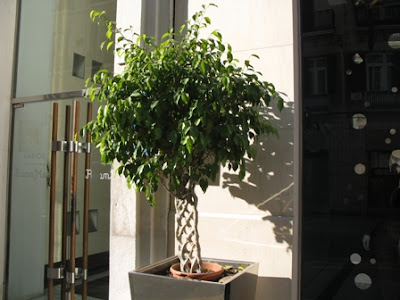
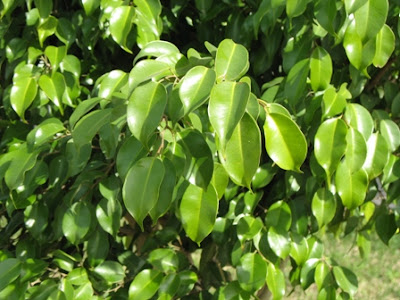
The Benjamin Fig (Ficus Benjamina) is one of the most common tree species that is used as an indoor potted plant. Although it is very well suited to be used in indoor settings the fact that it is a tree requires that it cared for following a few simple tips.
#One - Make sure that your Ficus plant is getting the right amount of sunlight. Ample light is necessary and some direct light for part of the day is fine but avoid a location that exposes to plant to direct sunlight for too long. Also keep in mind that these plants are very sensitive to changes. It is not uncommon for a Benjamin Fig to drop all of its leaves in response to a dramatic change. The trick is to find a good location and then don't move it!
#Two - Take care of your plant' s roots. The two main things you need to worry about are root rot and becoming root bound. To avoid root rot it is a good idea to not let you plant sit in standing water. If you over water and allow the plant to sit in a tray with the excess water root rot may develop which in turn will cause the leaves to start spotting and falling off. Water the plant only when the soil is almost dry, make sure the moisture gets to the roots but don't allow the excess water to collect at the base of the plant. In between these waterings you can also keep the plant happy by misting it every few days or so. To avoid the plant becoming root bound it will be necessary to trip back the roots every 3-5 years and possibly change up to a larger pot.
# Three - Keep your plant well fed. It is generally recommended to fertilize a Benjamin Fig monthly during the months that the plant is growing with a basic fertilizer diluted to at least half strength. It is important to feed your plant but it may be equally important to not overfeed it as well.
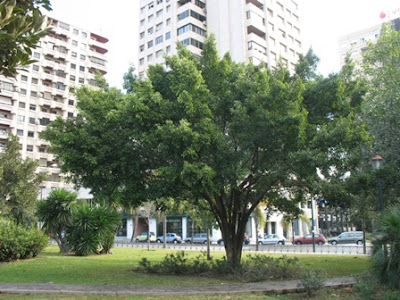
And remember, your plant is in fact a tree and is trying to become like the one below, so to keep it small and cute in an indoor setting you need to take care of it!
see also...
Fiddle Leaf Fig care tips
Money tree plants
Giant Sequoias at La Granja de San Ildefonso Segovia
There is in Spain a majestic palace at whose entrance you will find standing guard the most amazing collection of giant trees. The palace is located in the town of San Ildefonso in the province of Segovia, which if you are not familiar with Spain, is about an hours drive north-west of Madrid.
The Royal Palace at San Ildefonso was built by king Philip V starting in 1719 and was patterned a great deal on the French palace of Versailles which was built by Philip´s grandfather Luis XIV of France.
There are a great many trees around the royal gardens but in this post I want to focus on two Giant Sequoias near the front entrance of the main palace. Giant Sequoias are not native to Spain but there were most likely brought back to Spain by Spanish explorers who started establishing missions in California in the late 18th Century. The most reliable information that I have found states that the Sequoias of San Ildefonso were planted around the year 1870 which means that they are now about 140 years old.There are two Giant Sequoias at San Ildefonso. The one on the left in the image above has been called "el Rey" (the King) in Spanish and is 40 meters tall and has a trunk circumference of 13 meters. "the King" is more rugged looking of the two and has the look of having been broken off at the top at some point.
The other Sequoia is called "la Reina" (the Queen) and is 34 meters tall and has a trunk circumference of 9 meters. "the Queen" (image below) is definitely the better looking of the two and has a fine conical shape.
A sign near these trees identifies their species as well as those of the other great trees that stand nearby. I will mention some of these in a future post.
Ten Tallest Tree Species
#1 Coastal Redwood (Sequoia sempervirens)
- Hyperion: 379 feet (115 meters)
- Helios 376.3 feet
- Stratosphere Giant 370.5 feet
- Mendocino Tree: 368 feet
- Centurion: 101 meters
- Icarus Dream: 97 meters
- Mount tree: 96 meters
- Doerner Fir”, (previously known as the Brummit fir), 99.4 meters
- Cathedral Grove: 76 meters (249 feet)
#4 Sitka Spruce (Picea sitchensis)
- Carmanah Giant: 96 meters (315 ft)
- Quinault rain forest (191 feet)
- Giant Spruce of Cape Perpetua (185 feet)
- Redwood Mountain Grove: 94.9 meters
- Diamond Tree: 87.2 meters
- Hart Redwood: 84.8 meters
- General Sherman: 84.2 meters
- Tasmania: 90.7 meters
#7 White Gum (Eucalyptus viminalis)
#8 Noble fir (Abies procera)
- Goat Marsh Research Natural Area: 89.9 meters ( Mt. St. Helens National Monument)
#10 Yellow Meranti (Shorea faguetiana)
runner up - Shining Gum (Eucalyptus nitens)
- Tasmania - 84.4 meters
Tallest Hardwood Tree in the World
A new champion hardwood tree has recently been discovered in Tasmania, Australia. Standing at 101 meters tall the newly found Giant has been named "Centurion". The tree is a "Swamp Gum" (Eucalyptus regnans) and was discovered by Tasmanian forestry staff using an airbord "LIDAR" laser scanner.
While this tree is not the tallest tree in the world it is the tallest hardwood, the tallest flowering tree and the tallest tree in Australia. The world´s tallest tree is a Coastal Redwood by the name of "Hyperion" which is 114 meters (379 feet) tall. After the Coastal Redwood the Eucalyptus regnans in the world´s next tallest tree species.
The "Centurion" tree in Tasmania is located just 5 km from the Tahune airwalk. The discovery of this tree has been very exciting for forestry officials in Australia as it is the only hardwood tree in the world that stands more than 100 meters tall.
Other tall "Swamp Gum" trees in Australia are...
Icarus Dream - 97 meters
Mount Tree - 96 meters
Damocles - 93 meters
Medusa - 92 meters
Money Tree Plant - Pachira Glabra
One of the most common indoor potted tree plants is the "Money tree" (also known as the "Lucky money tree" or the "Bonsai money tree" or even "French Peanut"). There is considerable confusion it seems as to the species of tree that these "money trees" belong to. They are almost always listed as being "Pachira aquatica" in nurseries and plant shops. The truth however is that there are several species in the pachira genus that are used to make the braided money trees and in my opinion the most commonly used is not pachira aquatica but rather parchira glabra (sometimes called Bombax glabra or Bombacopsis glabra).
The differnce between the p. aquatica and the p. glabra can be easily seen in the fruit and the flower. p. aquatica has a flower with redish stamens while the p. glabra has a flower with creamy white stamens. The fruit of the p. aquatica is woody brown with a rough texture while that of the p. glabra is green and has a smooth surface.
These two distinctives are of little use however if what you are trying to do is identify a potted money tree plant that in all likelyhood will never have neither flower nor fruit pod. This leaves just the leaves as the source of differences to determine the true species.One of the reader comments on my previous post about the p. aquatica tiped me off to the difference. The venation of the p. glabra is more horizontal with respect to the petiole while the p. aquatica is slightly more angled. From my observations the leaflet shape is also slighly different with the p. glabra being a bit more long and pointy and the p. aquatica a bit more round and less pointed.
The images above and below are from a braided money tree plant that was planted in the Torrremolinos botanical garden "molino de inca". I happend to come across it when it had fruit that was mature enough to check the color and texture.
Links to pachira glabra sites...
http://www.montosogardens.com/pachira_glabra.htm
http://www.kartuz.com/p/80057/Pachira+glabra.html
http://www.esalq.usp.br/trilhas/fruti/fr04.htm
Japanese Maple - Acer palmatum
The Japanese maple (species name: Acer palmatum) is a small tree or large shrub in the Maple family that is native to the Asian countries of China, Korea and Japan. It is highly prized as a garden tree for its great ornamental beauty. It is the hallmark of every Japanese garden and is often found planted next to beautiful ponds with colourful Carp fish.The leaves are palmate with serrated margins and measure about 3-4 inches (8-10 cm) across. The leaves range in color from green to red to almost a deep purple on different cultivars. There are thousands of cultivars of this tree species that have been selected for their various leaf shapes and colors. The image below is of a variety with leaves leaning more towards red.
In the Seattle area I have seen Japanese Maples that are quite large, measuring over 20 feet tall often with multiple trunks that branch off close to the base of the tree. On smaller specimens the trees have been pruned to keep more of a dome or bonsai type shape.
The picture below was taken under a fairly large Japanese Maple in North Seattle.
Other Maples I´ve blogged about are...
Sycamore Maple, , Vine Maple, Big Leaf Maple, Red Maple, Boxelder Maple, Montpellier Maple
Indoor Fiddle Leaf Fig care tips
The Fiddle Leaf Fig tree is commonly used as an indoor potted plant. It is relatively easy to care for, has large beautiful leaves and has a slow rate of growth. In this post I will list seven tips for caring for this tree species in an indoor environment as well as links to sites with more information.
Tip #One
Make sure your plant has right amount of light. Abundant but not direct light is recommended. Too little light will cause the plant to loose leaves and thin out. It also tends to grow towards the light giving the impression that it is leaning. Rotate the plant every so often to keep it growing straight and to ensure bushiness.
Tip #Two
Don´t over water the plant. The Fiddle leaf fig does well with short dry periods between waterings. The frequency of watering depends on the amount of light the plant gets. One good way to determine how often you should water is to let the pot dry out until the new growth at the top begins to wilt slightly. Calculate the time that elapsed from the last watering and subtract a day or two to determine the ideal frequency of watering. This way you will be watering the plant just before it starts to wilt the next time.
Read more at...
http://www.farmlifenursery.com/Web%20pages/Lyrata%20care.htmTip #Three
Prune to encourage branching and bushiness. The Fiddle leaf fig tends to grow a tall single stem when indoors. This long stem will normally not be able to keep itself upright and will require some sort of support. To encourage a more "tree like" form prune the plant at a desirable hight while the plant is still fairly young. It is recommended to do this in early spring before the new growth forms.
Read more at...
http://www.marketblooms.com/plantcare/pdf/FiddleLeafFig.pdf
Tip #Four
Be careful not to expose the plant to dry heat or drafts. Like other Ficus tree plants the Fiddle leaf fig has a tendency to drop its leaves when exposed to too much dry heat or drafts and go into a sort of dormant recovery mode for a period of time. Some figs such as the Sacred Fig will do this as part of their normal growth cycle just prior to the growth of new leaves.Tip # Five
Clean the dust of the leaves once in a while to allow the plant to absorb as much light as possible. Often in indoor settings a layer of dust builds up on the leaves without our being aware of it and reduces the effective light that the plant gets. Every so often gently clean the leaves of with a soft cloth. Don´t try to do this with your hands as rubbing the leaves can damage them slightly and cause them to bleed little drops of white milky sap. Use latex gloves if you are allergic to this plant.
Tip #Six
Move your plant to an outdoor setting during the summer so that it can get more light. If you do this however transition it back indoors gradually at the end of the summer to avoid shocking the plant.
Tip #Seven
Trim the roots every year or two. The Fiddle Leaf Fig is a tree capable of growing to 40-50 feet tall with a normal root system for a tree that size. When roots grow in a small container they have little room to grow in and end up wrapping around the base of the container or growing out the bottom of the pot. Trimming the root system back during the dormant season will help keep the plant growth slow and will help maintain healthy roots.
http://forums2.gardenweb.com/forums/load/houseplt/msg0718401415535.html
http://plantcareguru.com/plant_care/fiddle_leaf_fig.php
Meryta Denhamii of New Caledonia
The Meryta Denhamii tree (this is also its binomial scientific name) is native to the south pacific island nation of New Caledonia (east of Australia). The Meryta Denhamii has long leaves. The leaves in these images are about 2-3 feet long (75cm) and about 8-12 inches wide (25cm).
The flowers of this tree species are quite interesting and unique as you can see from the images above and below. The individual ball like flowers are about 1 inch in diameter.
I photographed two trees for this post, both of which I found in the Spanish city of Malaga. The tree below is in the "paseo del parque" gardens that run along the port. The second tree was in the Picaso gardens along the Avenida de Andalucia.
The large leaves have a thick, stiff spine that runs the lenght of the leaf that helps keep its from.
The image below is of the bark on the main trunk of the tree. Malaga has a sub-tropical climate that does not experience freezing tempuratures which is one factor that has enable this tree species to be cultivated there.
Silver Wattle or Mimosa - Acacia dealbata
The Silver Wattle tree (species name: Acacia dealbata) is native to the southeastern Australian states of New South Wales, Victoria and Tasmania. In its native range it is reported to grow to an impressive 30 meters (98 feet) tall. In southern Europe however where the images in this post were taken the "Mimosa" as it is called in Spanish usually only reaches a height of about 20-30 feet.
Probably the most striking feature of the Silver Wattle is its bright yellow flowers that are blooming right at the moment (early March) in Madrid, Spain. The flowers are clustered in racemes and the puffy little flower heads are globose in shape and similar to the Golden Wreath Wattle that is also common in Spain.
The leaves of the Acacia dealbata are bipinnate (they are like a scaled down version of the Jacaranda leaf). Another tree that has very similar leaves and is sometimes confused with this tree is the Persian Silk tree. The White Popinac also has bipinnate leaves and globose flowers. The image above was taken in the "Polvoranca" park that is located between the Madrid suburbs of Leganes, Alcorcon and Fuenlabrada. The picture illustrates the typical rounded crown of this tree species.
The bark (at least on young trees) is greyish-brown and smooth (see image below).
Other Australian trees that can be found in Southern Spain are...